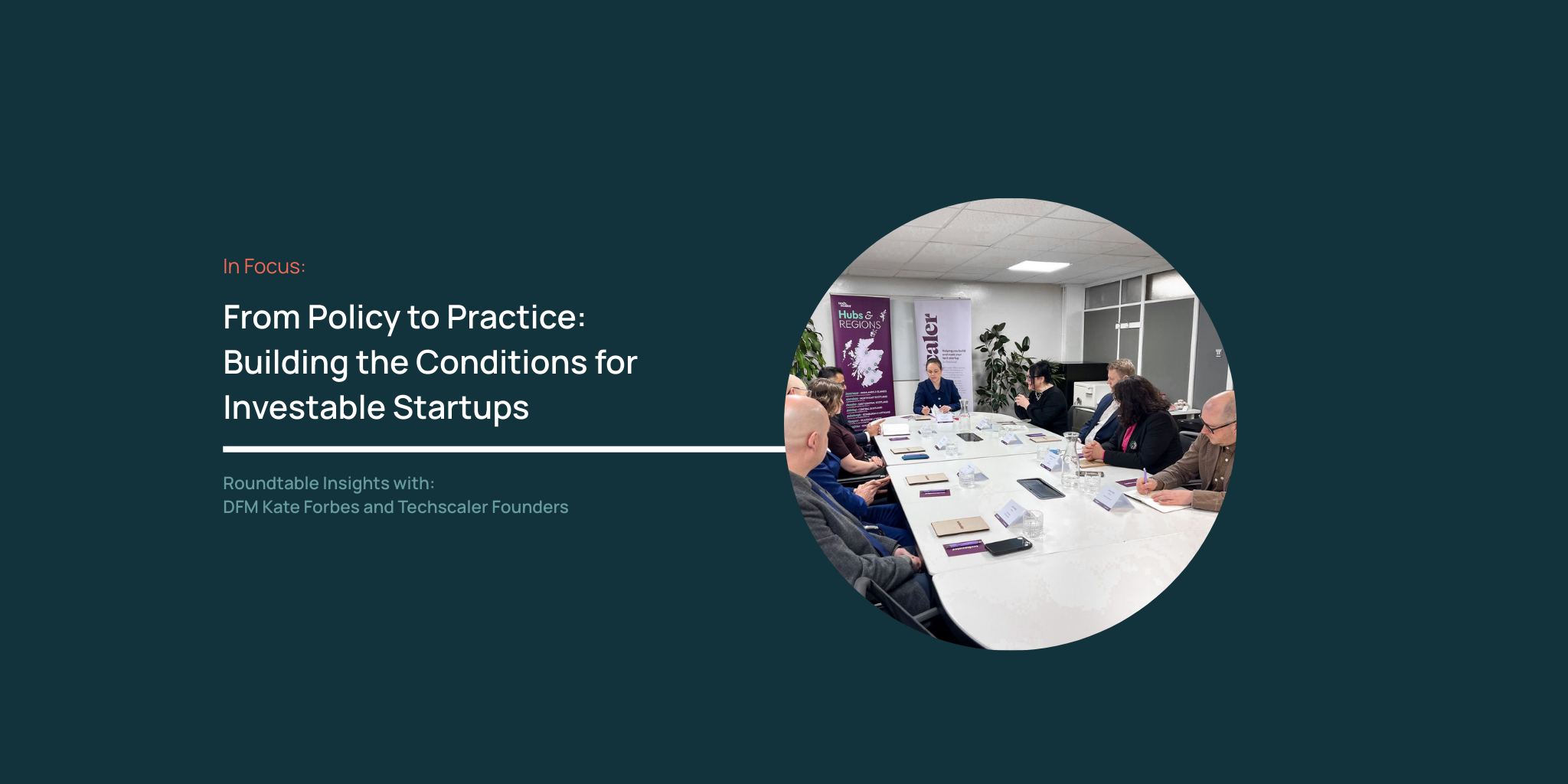
From Policy to Practice: Building the Conditions for Investable Startups
Scotland does not lack entrepreneurial ambition. What determines whether that ambition translates into investable, scalable companies is the strength of the ecosystem fabric around it. Over the past three years, Techscaler by CodeBase has been designed to strengthen that fabric, creating structured pathways into mentorship, capital, international markets, and peer networks across the country.
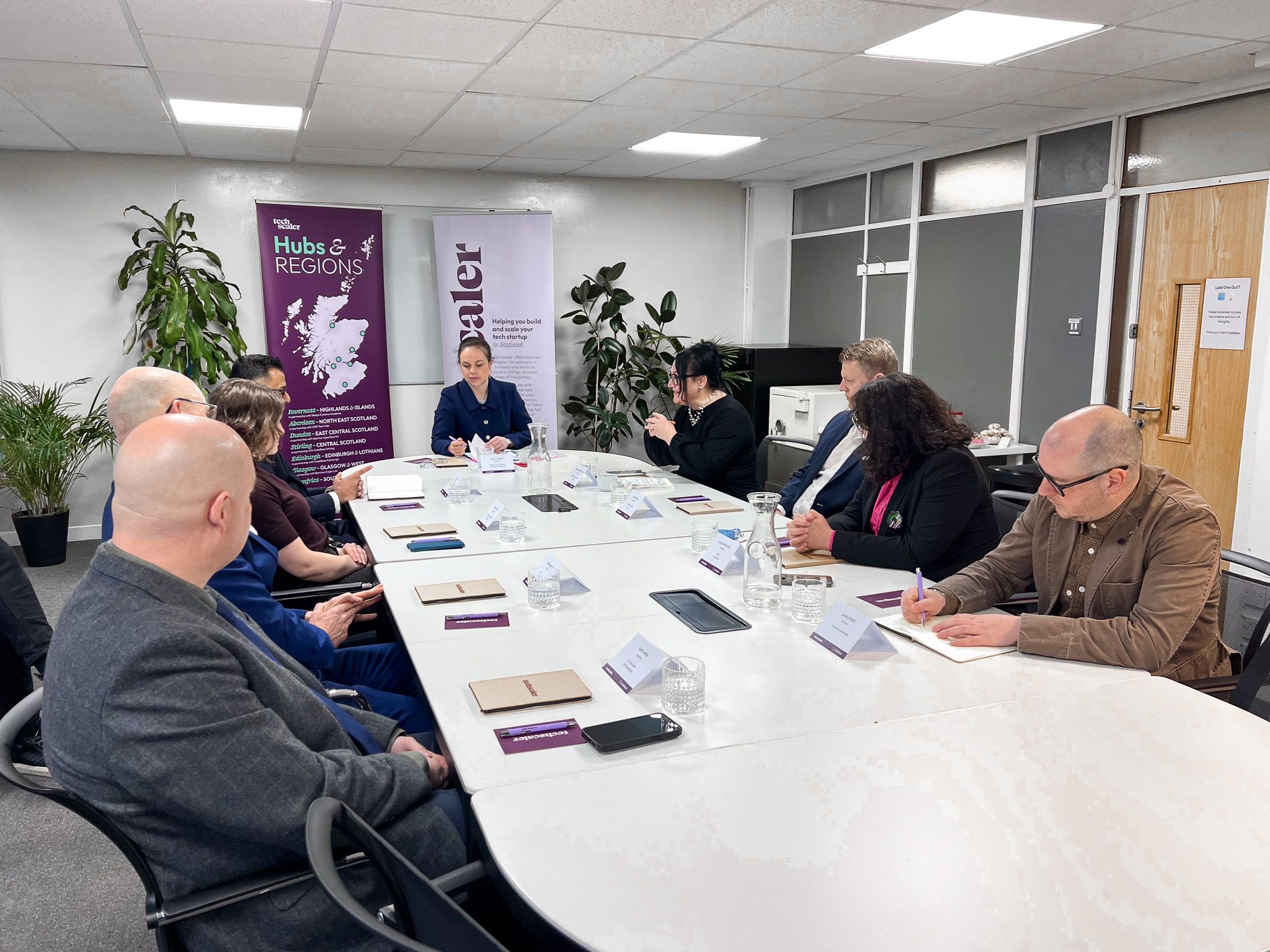
The recent Techscaler roundtable brought that work into sharp focus. It convened founders operating at different stages of growth to reflect on what has tangibly shifted in their journeys and where ecosystem design has reduced friction in practice. It was less a theoretical discussion and more an examination of how sustained intervention begins to compound.
Deputy First Minister Kate Forbes MSP joined the session as part of the wider ecosystem dialogue. The discussion revisited the origins of Techscaler, which began with a commissioned review of Scotland’s technology ecosystem and the recognition that structural coordination was required to unlock founder potential at scale. What followed was a funding commitment and delivery model designed to provide consistent national infrastructure rather than isolated interventions. The roundtable reflected on how that early rationale has translated into tangible outcomes, with founders now demonstrating the compounded effects of structured access to mentorship, markets and capital.
What made this roundtable a standout one was the range of founder experience in the room. The group was representative of different stages and different types of complexities:
- Ayub Shoaib of NOMW discussed navigating partnerships and hiring while developing a wearable product for overdose detection.
- Gus Laing of All Trade Link spoke from the position of switching sectors, spotting a problem in construction, and learning how to build and sell a SaaS product without a prior tech background.
- Chris Helson of Tiny Air described the realities of scaling regulated medical technology across health systems and into international markets.
- Dr. Giulia Marcucci of LumiAIres and Eva Steele of Amytis both brought the perspective of translating academic depth into commercial clarity, with all the communication and confidence shifts that require.
- Sam Mayall of Zelim added a long arc view of growth, lessons learned, and the role of mentoring relationships, including informal support that can sit alongside formal programmes.
That breadth of experience and discussion reflected in the panel is not incidental. It is an intentional design of how an ecosystem teaches itself. When founders at different stages share what actually moved the needle, the ecosystem gains pattern recognition. What comes to the fore then is individual progress as well as systems that reduce friction for other founders who are starting out.
“
I can't build your businesses, but I need your businesses. So your businesses and your ideas and your entrepreneurship and your determination and your grit and your focus and your walking, hopefully forward. All of that is for you. If you can have an enabling environment to make that successful, then we've got a great partnership.
DFM Kate Forbes
Getting your foot in the door
Several founders described Techscaler as a door opener. That phrase can sound abstract until it is unpacked for what it means in practice.
Ayub Shoaib described how, soon after reaching out, he was in conversations that helped him learn quickly, including being on stage alongside senior clinical and scientific voices. The kind of proximity that builds credibility, sector understanding, and momentum, particularly when a founder is navigating partnerships for the first time.
He also referenced community-enabled hiring, using a community board to find a resource, which signals a key source strong ecosystems can provide: trusted channels for talent and contribution.
Dr. Giulia Marcucci described a similar experience framed around validation and market proximity. She spoke about the combined value of being in Silicon Valley, meeting people where industry-leading technology is produced, while also being connected to green technology networks and enterprise conversations.
She directly linked this to practical outcomes, including investor conversations becoming easier after support in shaping narrative and message, and team growth through relationships formed via the programme.
Eva Steele described her experience of receiving the first Techscaler newsletter, wherein she found an opportunity from a London-based VC, Black and Green Capital, offering a £60K accelerator investment. That investment helped Eva resolve a match-funding challenge she was facing to progress a Smart Scotland grant.
For any ecosystem to be able to make the most of all available opportunities, it is key to remember that founders do not always need a new initiative. They often need the right information at the right time, signposted through trusted channels.
The principle running through these stories is proof of how access is not evenly distributed. Intentionally designed and developed ecosystems narrow that gap by creating repeatable routes into expertise, networks, capital, and decision makers.
Mentorship as Social Infrastructure, Not a Service Line
Mentorship, another key topic of discussion, was brought up as a much-needed social infrastructure. Cast by these founders as a pathway of how tacit knowledge moves through a region.
Sam Mayall spoke about early mistakes and expensive learning, and how mentorship can shortcut pitfalls, particularly around access to capital and the craft of framing an investment pitch in a way that actually unlocks commitment.
He also emphasised that mentorship is fundamentally relational. Trust and listening determine whether it works. It is a design requirement where, often, a rigid, transactional approach fails because founders do not change behaviour based on generic advice.
Chris Helson described mentorship at the other end of the spectrum, where the need is less about starting and more about scaling in complex markets. He spoke about being introduced to high-level, experienced people with a global context and about the value of deep dive work rather than generic guidance.
This included introductions through Techscaler and sustained hands-on support as Tiny Air pursued international opportunities, including Singapore.
A key ecosystem insight sits here: mentorship quality is defined by fit more than numbers. Fit that spans across stage, sector, and ambition. When those align, mentorship becomes an engine to boost capability and output.
“
We applied to the Techscaler for the Singapore trip. And before we went to Singapore, we met a couple of times, there was opportunities to meet mentors. They really listened, and they understood where we were at, what the problems were, and they introduced us to the right people.
Chris Helson, Co-Founder. Tiny Air
Translating Academic Excellence Into Commercial Confidence
Another major thread of discussion was the transition from academia into entrepreneurship, discussed by Dr. Giulia Marcucci and Eva Steele.
Marcucci described years in academia across multiple institutions and countries, and highlighted a tension that many researchers recognise: even in academia, a significant amount of time is spent securing funding and managing projects. A topic we saw at the forefront of Ecosystem Exchange 2025 as well.
The shift in entrepreneurship is fundraising for a path to real-world impact, with market validation as the feedback loop. She described conversations with major technology companies in Silicon Valley as moments where the work felt real and urgent rather than theoretical.
Steele added a highly practical lens on communication. She described the cultural difference between academic caution and the expectations of investors and customers, where excessive reservation can be interpreted as uncertainty.
She also described the challenge of jargon and the steep learning curve when entering investor conversations early on.
Scotland produces deep technical talent; that much has always been true. However, sustained ecosystem advantage will come from making translation easier, faster, and less isolating, so that more research-led founders can move into venture building without losing momentum in the shift.
“
The only difference is that when you move to business, you are doing that for something that create a real impact. For example, in my specific case, when I realized that I had in my hand something that could solve one of the biggest problem in the moment in this modern area, which is the energy consumption of artificial intelligence.
Dr. Giulia Marcucci, Co-Founder, LumiAires
Government’s Role in Pushing the First Domino, Then Staying Responsive
Kate Forbes described the evolution of Techscaler from commissioning the Mark Logan ecosystem report, to securing funding to seeing founders pitch internationally years later.
Her framing was grounded in the fact that the government cannot build individual companies, but it can surely create the enabling environment that makes success more likely.
She also made a distinction that matters to every ecosystem stakeholder: most government activity is necessarily rigid because of public money, metrics, and reporting. Techscaler, in contrast, needs to remain flexible and responsive to founder feedback, with mentorship and certain funding elements working in a less bureaucratic, more adaptive way.
That is a core design principle for ecosystem infrastructure. The support system must not mirror the friction founders already experience elsewhere.
The roundtable also shed light on a broader point about confidence. DFM Forbes spoke about the importance of self-belief for entrepreneurs from different sectors and walks of life, and about the moment when someone sees a problem in their industry and believes they can be the one to fix it.
What the Ecosystem Should Take Forward
One of the most valuable parts of this discussion was that it revealed how ecosystem outputs are created through a chain of small but connected interventions. Not a single silver bullet, but a set of conditions that reinforce each other.
The roundtable pointed to several design truths that matter across government, universities, corporates, investors, and founder communities:
- Information flow creates opportunity: Eva Steele’s experience shows how a single surfaced opportunity can unlock funding pathways at the right moment.
- Trust reduces risk: Steele also described being warned off an unsuitable investor route through community connections. That is ecosystem protection in action.
- Mentorship must be matched, not mass produced: Helson’s experience demonstrates the value of precise, high-calibre guidance when the stakes are global and regulated.
- Translation support turns expertise into investability: Marcucci’s narrative shaping support changed investor conversation quality, which is a lever for capital and scale.
- Responsive infrastructure is a competitive advantage: DFM Forbes’ emphasis on flexibility speaks to how Scotland can differentiate as a place where founders are enabled, not processed.
The roundtable keyed in on what is working, where friction still lives, and which conditions most directly convert founder potential into sustainable, investable progress. Most importantly, it reinforced that ecosystem building is not performed by one contributor alone. It is a symbiotic system, and when it is designed to be connected, founders move faster, capital finds stronger propositions, and regions build credibility on the global stage.




.svg)