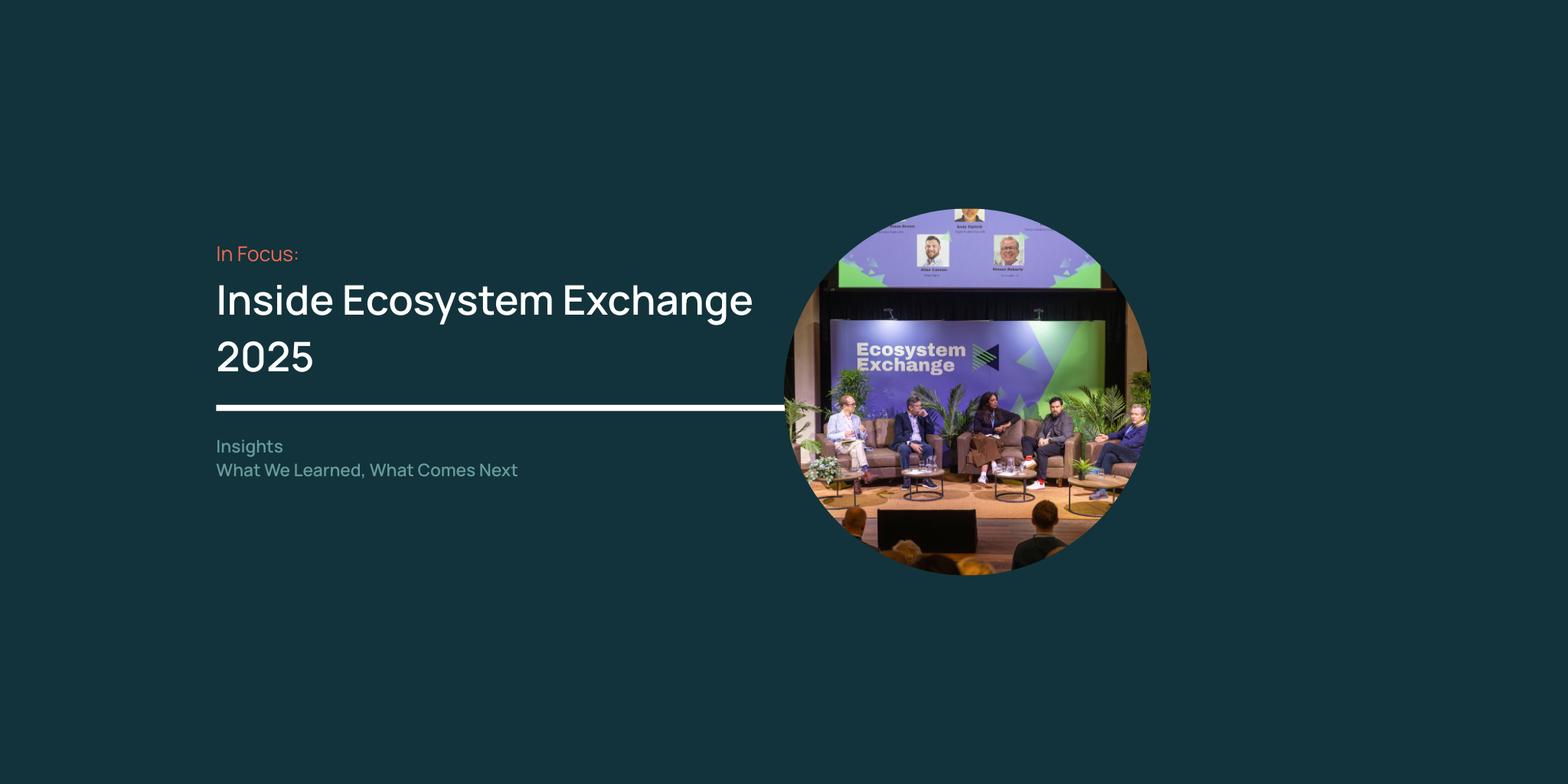
Inside Ecosystem Exchange 2025
The UK is entering a pivotal decade for innovation. AI is reshaping industries faster than governance or support systems can keep up. Global competitors are accelerating. The gap between scientific excellence and commercial impact remains wide. Against this backdrop, Ecosystem Exchange 2025 brought together more than 210 leaders from across the country to confront a single question: What will it take for the UK to build an innovation ecosystem that competes at global scale?
Hosted in Edinburgh by CodeBase, Barclays Eagle Labs and the Edinburgh Futures Institute, the two-day gathering shaped a national forum for clarity, challenge and alignment. What emerged was neither a list of problems nor a set of easy solutions, but a sharper understanding of the choices the UK must make in order to unlock the full potential of its founders, universities and regions.
What we have below is a glimpse into some of the core themes explored inside the room. Signup for the full report to access a deeper, more structured account, including insights from keynote speakers, panels, interactive sessions and national ecosystem leaders.
The UK Has Assets. The Work Now Is Alignment.
Across the event, one message echoed repeatedly: the UK does not lack talent, research capability or ambition. Its universities are world renowned, regional ecosystems are growing, and a new generation of founders is emerging with global aspirations.
What the country lacks is coherence.
Participants reflected on the increasing friction founders experience as they navigate support services, funding routes, academic pathways and regional initiatives. Despite a wealth of resources, the system remains too fragmented for companies that need speed, clarity and coordinated support.
This was particularly evident in conversations on:
- Slow translation of research into commercial readiness
- Inconsistent access to experienced operators
- Regional disparities in capability and pathways
- Limited visibility of high-potential companies still operating under the radar
The opportunity now is structural. The UK must decide whether its ecosystem will remain a collection of parallel efforts or evolve into a connected national platform that accelerates ambition rather than slowing it down.
AI Is Changing Not Only Products, But the Nature of Ecosystems
A defining feature of this year’s conference was the shift from talking about AI as a technology to understanding AI as an operating model.
In her interactive session, Natalia Loza challenged the traditional assumptions baked into support systems built for software companies of the last decade. AI-native founders need something fundamentally different: data-ready environments, computational infrastructure, rapid-validation pathways and models of trust that keep pace with algorithmic change.
Throughout the event, participants acknowledged that the UK risks falling behind if its support architecture does not evolve. The question is not whether the UK will have AI companies - it already does. The question is whether those companies will be built on infrastructure designed for a different era.
The implications are potentially profound:
- Acceleration in decision cycles
- New expectations around data governance
- A redefinition of “product-market fit” in algorithmic contexts
- The need for operators who understand the mechanics of AI-first ventures
Ecosystem Exchange made one reality clear: AI is not a sector. It is a new foundation layer, and the UK must reorganise around it.
Universities Hold Immense Untapped Economic Power
One of the most charged discussions centred around the role of universities in the UK’s growth story.
Speakers and participants recognised a structural tension: while the UK produces globally recognised research, the pathways between discovery, commercialisation and scale are still uneven. Many regions lack the connective tissue needed to turn academic breakthroughs into real-world solutions.
This challenge is not new, but at Ecosystem Exchange it was articulated with unusual clarity:
- Academics should not be expected to become founders. They need operators, mentors and applied pathways around them.
- Commercial capability, product, market, execution, must be embedded much earlier.
- Alumni networks remain an underused strategic asset compared with global peers.
- Universities cannot be engines of innovation in isolation. They require industry and investor alignment to accelerate economic impact.
The key takeaway was that the potential of Universities is far greater than current structures allow.
Regions Are Ready to Lead, If the System Lets Them
One of the strongest signals of momentum came from regional leaders. Whether speaking from the vantage point of Manchester, Aberdeen, Edinburgh or emerging clusters across England and Wales, the message was consistent: regional capability is growing, but not yet fully empowered by national strategy.
Through keynotes, fireside conversations and panel exchanges, several patterns emerged:
- Regions with strong industrial heritage are becoming natural testbeds for innovation.
- Ecosystem builders outside London are driving new models of collaboration that blur traditional sector boundaries.
- International partnerships, rather than domestic competition, are proving decisive in shaping regional growth.
Ecosystem Exchange demonstrated that the future will not be built by a single hub. It will be shaped by interconnected regions that share knowledge, infrastructure and ambition.
Culture Will Shape the Next Chapter
Beneath the structural and strategic conversations at Ecosystem Exchange 2025, a deeper current ran through the room: culture is becoming as decisive to the UK’s competitiveness as capital, talent or technology. The next generation of founders expect ecosystems that are open, porous and designed for speed. They seek environments where capability outweighs geography, where access replaces gatekeeping, and where collaboration is not an aspiration but the norm. When ecosystems fall short of those expectations, ambition disperses long before scale becomes possible.
This cultural shift is also reshaping Ecosystem Exchange itself. The event is evolving into something more intentional, with a stronger commitment to depth over density and dialogue over volume. Participants made clear that the future of the Exchange lies in sharper conversations, more founder-led insight, richer cross-sector learning and a model that treats delivery partners not as contributors but as co-architects. The result is a platform designed to reflect how modern ecosystems actually operate: connected, curious, and built around the belief that progress accelerates when diverse groups collide with purpose.
Click to access the full report, including panel breakdowns, strategic insights, speaker perspectives, mentimeter reflections and guidance for the year ahead.




.svg)