Venture Builder Incubator Showcase
Scotland’s deep tech pipeline continues to mature as universities, ecosystem organisations and investors align around a shared objective: translating research excellence into globally relevant companies.
The Venture Builder Incubator 6.0 Showcase at the National Museum of Scotland offered a clear view of that momentum. The programme, delivered by the Bayes Centre at the University of Edinburgh in partnership with Techscaler, brought together founders, academics, investors and ecosystem partners to celebrate the progress of a cohort that has spent the past five months transforming early research ideas into startup ventures.
The scale of collaboration behind this cohort reflects the direction of travel for the Scottish ecosystem. Through a new partnership with Techscaler, VBI 6.0 welcomed founders from a record ten Scottish universities, while a partnership with Cancer Research Horizons supported five researchers from across the UK focused on oncology related innovation.
For many in the room, the showcase served as a reminder that the future of deep tech entrepreneurship depends on strong bridges between academia, industry and startup infrastructure. Programmes like Venture Builder Incubator create those bridges by helping researchers navigate the earliest stages of company formation while connecting them with the networks and expertise needed to move forward with confidence.
Opening the evening, CodeBase’s Andrew Parfery reinforced the importance of community around founders as they take their first steps into company building, reminding the room that entrepreneurship becomes far more achievable when founders know the ecosystem is working alongside them.

Deep Tech Ideas Moving Toward Market
Fourteen ventures pitched during the showcase, representing research emerging from universities across Scotland and the wider UK. The ideas spanned health and life sciences, climate innovation, artificial intelligence, digital infrastructure and advanced hardware.
Across the cohort, a clear pattern emerged where many teams can be seen working on problems that sit at the intersection of scientific discovery and real world application, often tackling bottlenecks that have historically slowed progress in sectors such as healthcare, energy and advanced manufacturing.
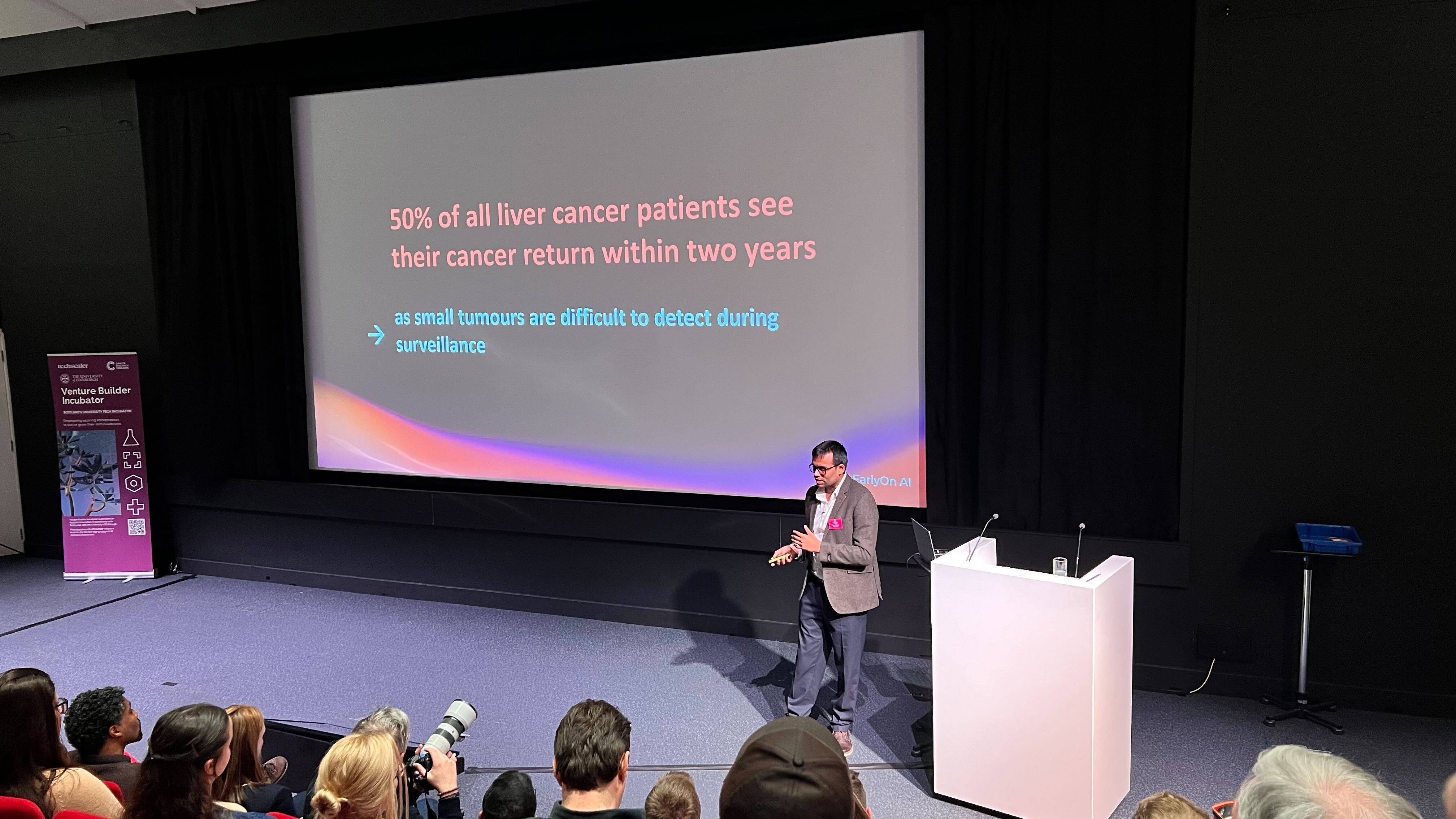
Several ventures are focused on accelerating drug discovery and clinical research. Tudels is developing a new approach to drug discovery that aims to dramatically reduce the time and cost associated with early stage experimentation. Derisk Bio is addressing the gap between research breakthroughs and clinical validation through an AI powered platform designed to connect discovery research with real clinical requirements earlier in the development process. EarlyOn AI is working on AI driven detection of liver cancer capable of identifying sub millimetre tumours, while Cadence Dx is building new diagnostic approaches that aim to improve the speed and accuracy of heart attack detection.
Alongside life sciences innovation, founders presented new technologies designed to modernise industries that have historically lacked strong digital infrastructure. TheiaMuse is building tools that help museums identify and evaluate potential exhibitions more efficiently, while Neon Guard’s Age Engine platform explores new approaches to age verification that do not rely on identity documents or facial recognition.
Hardware innovation was another notable theme. SceneAI is developing handheld chemical sensing technology designed to detect variation between brewery batches, and Cortical Harmonics is building wearable neurotechnology that could significantly lower the cost barrier to brain computer interface devices.
Climate and energy solutions also featured strongly. Aeroflow is tackling fuel efficiency in heavy goods vehicles through aerodynamic improvements that could deliver significant reductions in fuel consumption, while Faust Electric is exploring point of consumption wind turbines designed to generate renewable energy closer to where it is used.
Other ventures are addressing agricultural and consumer challenges, including Ovation Agriculture’s device designed to prevent bovine dental disease and Little Moments, a mindfulness platform aimed at supporting bonding between parents and infants.
Together, the cohort demonstrated the breadth of research driven innovation emerging from Scotland’s universities and the growing ambition among researchers to translate that work into real businesses.
Lessons from the Spinout Journey
The evening also featured a keynote from Professor Brian Quinn, founder of WellFish Tech, a spinout from the University of the West of Scotland that has grown from an early research concept into a company approaching a Series B funding round.
Quinn’s story resonated with many founders in the room because it captured the realities of moving from academic research into company building. He reflected on the importance of strong industry partnerships and the willingness to adapt leadership structures as companies scale.
At one stage in WellFish Tech’s growth, Quinn recognised that remaining CEO was beginning to limit the company’s progress. Stepping back from the role allowed the business to accelerate its development and bring in leadership better suited to the next stage of scale.
For early stage founders emerging from academic environments, that lesson is often one of the most important. Building a company requires a different set of decisions and responsibilities than running a research programme, and successful spinouts frequently depend on recognising when new skills and leadership are needed.
Recognising Standout Ventures
The showcase concluded with three awards recognising standout teams from across the cohort.
• Cadence Dx received the Audience Award, presented by CodeBase COO Richard Lennox.
• EarlyOn AI received the Cancer Research Horizons Award for its work on improving early detection of liver cancer.
• Neon Guard received the Judges Award, presented by CodeBase’s Andrew Parfery.
These recognitions highlighted the quality of work emerging from the programme and the strong potential of several ventures as they move toward their next stage of development.
Strengthening the Pipeline for Deep Tech Founders
The Venture Builder Incubator continues to play an important role in Scotland’s innovation ecosystem by helping researchers take the first step from academic discovery to venture creation.
As universities increasingly focus on commercialising research, programmes like VBI provide the practical support needed to translate deep tech ideas into companies that can attract investment, create jobs and deliver real world impact.
For ecosystem partners across academia, government and industry, the showcase offered a clear signal of what is possible when research talent is supported by the right infrastructure.
Applications for Venture Builder Incubator 7.0 are expected to open in May, with the next cohort beginning in October 2026.





.svg)